

Learn : Characteristic Strength of Materials :Characteristic Strength of Concrete, Characteristic Strength of Steel. and Characteristic Load or ultimate load
CHARACTERISTIC VALUES (REFER CLAUSE 36, IS CODE)
Characteristic Strength of Materials
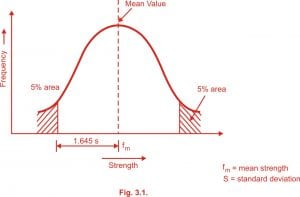
The characteristic strength is based on the statistical analysis of the test results because there are variations in the strength of the material used. In order to simplify the analysis, it may be assumed that the variation in strength follows a normal distribution curve which is symmetric about the mean value as shown below in Fig. 3.1.

Therefore, characteristic strength = Mean strength – k S
where S is the standard deviation, k=1.64, corresponding to 5% probability
\[\therefore f_{ck}=f_{m} – 1.64 S\]
Characteristic Strength of Concrete
The term characteristic strength means that value of strength of material below which not more than 5% of the test results are expected to fall. It is denoted by fck is N/mm2. The value of fck for different grades of concrete are specified by IS code 456:2000 and given in Table 1.1
TABLE 1.1. Grades of Concrete, Characteristic Strength of Concrete
| Group | Designation | Characteristic Compressive Strength, fck (N/mm2) |
| Ordinary
Concrete |
M10
M15 M20 |
10
15 20 |
| Standard
Concrete |
M25
M30 M35 M40 M45 M50 M55 |
25
30 35 40 45 50 55 |
| High Strength Concrete | M60
M65 M70 M75 M80 |
60
65 70 75 80 |
Characteristic Strength of Steel
The characteristic strength of steel is taken as the minimum yield stress or 0.2 percent proof stress specified by various Indian standards. In the case of mild steel it is taken as equal to minimum yield strength and is the case of HYSD bars it is taken as equal to 0.2 percent proof stress the values of characteristic strength of various types of steel are given in Table 1.9
TABLE 1.9.
| S.No. | Type of Reinforcement | Sub-Type | Relevant Indian Standard |
| 1. | Mild steel plain bar | (a) Cold worked mild steel bars
(b) Hot rolled mild steel bars |
IS 432-1996 (Part-I)
IS 1139-1966 (Part-II) |
| 2. | High yield strength
deformed bars (Tor steel) |
(a) Cold worked deformed bars
(i) Grade Fe 415 (ii) Grade Fe 500 (b) Hot rolled deformed bars |
IS 1786-1979
IS 1139-1966 (Part-II) |
| 3. | Hard drawn steel wire fabric | Wire mesh | IS 1566-1967 |
| 4. | Rolled steel members | Angles, T-sections Joists,
Channels etc. |
IS 226:1975 |
| 5. | (i) Thermo-mechanically treated bars (TMT)
(ii) Corrosion resistant steel (CRS) bars |
Latest in use deformed bars |
Characteristic Load or ultimate load
The characteristic load is the ultimate load that is liable to come on structure during its lifetime. For simplicity, the variation in the loading is also assumed to follow a normal distribution cure, the characteristic load or ultimate load is given as
Characteristic load or ultimate load = Mean load + 1.64 S
\[W_{u}=W_{m} + 1.64 S\]
Characteristic load is that value of load which has a 95 percent probability of not being exceeded during the life time of the structure. In absence of any data, loads given in various standards shall be assumed as the characteristic loads. The following standards may be used for this purpose.
IS 875 (Part 1) – for dead loads
IS 875 (Part 2) – for imposed loads
IS 875 (Part 3) – for wind loads
IS 875 (Part 4) – for snow loads
IS 1893 (Part 1) – for earthquake loads
 Civilengineering
Very nice would be fortunate if you would check about my writing….
http://www.druviconstructionconsultants.com/
LikeLike
information on this blog is good, really great but I want say that structure design can be made by using computer aided designing. and it is more time saving.
LikeLike