
Skip to content
CIVIL

Civilengineering

Tutorial

  • Home
  • About
  • Contact
  • Home
  • About
  • Contact

Category: Working Stress method

Working Stress method

This method of design was the oldest one. It is based on the elastic theory and assumes that both steel and concrete are elastic and obey Hook’s law. It means that the stress is directly proportional to strain up to the point of collapse. Based on the elastic theory, and assuming that the bond between steel and concrete is perfect, permissible stresses of the materials are obtained. The basis of this method is that the permissible stresses are not exceeded any where in the structure when it is subjected to worst combination of working loads.

In this method, the ultimate strength of concrete and yield strength or 0.2% proof stress of steel are divided by factors of safety to obtain permissible stresses. These factors of safety take into account the uncertainties in manufacturing of these materials. As per IS456, a factor of safety of 3 is to be used for bending compressive stresses in concrete and 1.78 for yield/proof strength of steel.
The main drawbacks of the working stress method of design are as follows :

(i) It assumes that concrete is elastic which is not true as the concrete behaves in-elastically even on low level of stresses.

(ii) It uses factors of safety for stresses only and not for loads. Hence, this method does not give true margin of safety with respect to loads because we do not know the failure load.

(iii) It does not use any factor of safety with respect to loads. It means, there is no provision for the uncertainties associated with the estimation of loads.

(iv) It does not account for shrinkage and creep which are time dependent and plastic in nature.

(v) This method gives uneconomical sections.

(vi) It pays no attention to the conditions that arise at the time of collapse.

The working stress method is very simple and reliable but as per IS 456:2000 the working stress method is to be used only if it is not possible to use limit state method of design. Working stress method is the basic method and its knowledge is essential for understanding the concepts of design.
CIVILENGINEERING SUBJECTS TUTORIAL Limit State Method R.C.C. STRUCTURE DESIGN Working Stress method

comparison of working stress method and limit state method

by sanjay sharmaDecember 8, 2017August 26, 2023
Continue Reading
Types of problem in T Beam
Working Stress method

Types of problem in T Beam | Working Stress Method
by sanjay sharmaDecember 7, 2017February 22, 2020
Continue Reading
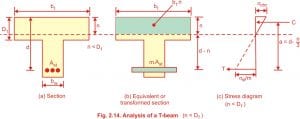
Analysis of T beam working stress method
Working Stress method

Analysis of T beam working stress method

by sanjay sharmaNovember 18, 2017February 22, 2020
Continue Reading
Working Stress method

T beams and terms used in T beams in Reinforced cement concrete

by sanjay sharmaNovember 18, 2017August 26, 2023
Continue Reading
Working Stress method

Steel beam theory is used to find the MR of doubly reinforced beam

by sanjay sharmaNovember 18, 2017February 22, 2020
Continue Reading
Working Stress method

Types of problem in doubly reinforced beams working stress method

by sanjay sharmaNovember 18, 2017February 22, 2020
Continue Reading

Posts navigation

Older posts

civilengineering.blog

Civilengineering subjects

  • Building construction (17)
  • Building material (36)
    • Bricks (9)
    • Cement (6)
  • Civil Engineering Drawing (1)
  • CIVILENGINEERING SUBJECTS TUTORIAL (225)
    • Estimating and costing (5)
    • Irrigation engineering (206)
    • Soil mechanics and foundation Engineering its application (8)
      • Preliminary definitions (7)
  • Concrete technology (9)
  • Education (8)
  • Fashion (4)
  • Hydraulics and Fluid Mechanics (2)
    • Properties of fluid (1)
  • Music (4)
  • Photography (7)
  • R.C.C. STRUCTURE DESIGN (37)
    • Limit State Method (12)
      • Design of singly reinforced beam (2)
    • Reinforced cement concrete (7)
    • Working Stress method (14)
  • SFD AND BMD (8)
  • Strength of material(SOM) (5)
  • Surveying (4)
  • Technology (4)
  • Theory of structure (TOS) (5)
  • Uncategorized (42)
  • WordPress (9)

Archives

  • August 2021 (2)
  • February 2021 (16)
  • January 2021 (26)
  • December 2020 (23)
  • November 2020 (44)
  • October 2020 (51)
  • September 2020 (23)
  • August 2020 (22)
  • July 2020 (1)
  • June 2020 (6)
  • May 2020 (1)
  • April 2020 (5)
  • March 2020 (1)
  • February 2020 (10)
  • January 2020 (2)
  • August 2019 (15)
  • May 2019 (12)
  • December 2017 (12)
  • November 2017 (34)
  • October 2017 (27)
  • September 2017 (53)
  • December 2016 (1)

Authors

  • sanjay sharma's avatar sanjay sharma
    • Basics of Cement concrete
    • Structural Engineering
    • Meter and non meter fall
    • Canal Regulation Works
    • Elementor #5517

Follow me on Twitter

My Tweets

Civilengineering

Tutorial

  • Home
  • About
  • Contact
  • Facebook
  • LinkedIn
  • Facebook
  • Twitter
  • LinkedIn
  • Instagram
  • Twitter
  • Instagram
  • Download Checkout
  • Our Blog
  • Contact
  • Pricing
  • Lifter Lms Checkout
  • About
  • Lifter Lms Dashboard
  • Courses List
  • Civil engineering courses
  • Single Page
  • Lifter Lms Membership
  • Home
  • Shop
  • Elementor #26070
  • Basket
  • Checkout
  • My account
Blog at WordPress.com.
Civilengineering
Blog at WordPress.com.
  • Subscribe Subscribed
    Civilengineering
    Join 25 other subscribers

    Have a WordPress.com account? Log in now.

  • Civilengineering
    View site in Reader
    Manage subscriptionsSign upLog in
    Report this content
    Collapse this bar
Loading Comments...