
Tag: Limit state of collapse in flexure
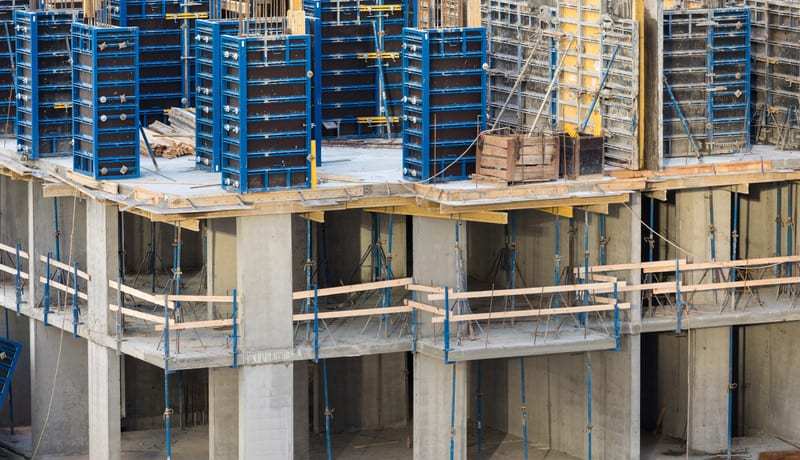
[caption id="attachment_2405" align="aligncenter" width="300"] slab beam column system under transverse loads[/caption]
Limit state of collapse in flexure
Reinforced concrete beams and slabs carry loads primarily by bending. They are, therefore, designed on the basis of limit state of collapse in flexure. The beams are also to be checked for other limit states of shear and torsion. Slabs under normal design loadings (except in bridge decks etc.) need not be provided with shear reinforcement. However, adequate torsional reinforcement must be provided wherever needed.
This topic explains the basic governing equations and the computation of parameters required for the design of beams and one way slabs employing limit state of collapse in flexure. There are three types of reinforced concrete beams:
(i) Singly or doubly reinforced rectangular beams
(ii) Singly or doubly reinforced T beams
(iii) Singly or doubly reinforced L beams
considered as rectangular for the negative moment and T for the positive moment. While for the intermediate spans of slabs the beam under positive moment is considered as T, the end span edge beam is considered as L beam if the slab is not projected on both the sides of the beam. It is worth mentioning that the effective width of flange of these T or L-beams is to be determined which
depends on:
(a) if it is an isolated or continuous beam
(b) the distance between points of zero moments in the beam
(c) the width of the web
(d) the thickness of the flange
Assumptions in limit state of collapse in flexure (Bending)
 Civilengineering