

Category: Irrigation engineering
Irrigation engineering
Irrigation engineering : in agriculture, artificial watering of the land. Although used chiefly in regions with annual rainfall of less than 20 in. (51 cm), it is also used in wetter areas to grow certain crops, e.g., rice. Estimates of total irrigated land in the world range from 543 to 618 million acres (220 to 250 million hectares), almost half of them in India, Pakistan, and China. The United States had almost 60 million acres (23.8 million hectares) of irrigated farmland in 1991.
In Irrigation engineering Methods of applying water include free-flooding of entire areas from canals and ditches; check-flooding, in which water flows over strips or checks of land between levees, or ridges; the furrow method, in which water runs between crop or tree rows, penetrating laterally to the roots; the surface-pipe method, in which water flows in movable slip-joint pipes; sprinklers, including large-scale center-pivot and other self-propelled systems; and a variety of water-conserving drip and trickle systems. In many cases irrigation is correlated with drainage
to avoid soil salinity, leaching, and waterlogging. Irrigation may also involve preliminary clearing, smoothing, and grading of land. Especially in areas of high evaporation rates, intensive irrigation can result in excessive quantities of salts accumulating in the upper layers of the soil as water evaporates from the surface, rendering the soil unfit for crop production.
Since prehistoric times water has been diverted from waterways to fields by ditching. Early improvements for raising water included counterbalanced poles with attached water vessels, and adaptations of the wheel and of a pump called the Archimedes’ screw. The use of canals, dams, weirs, and reservoirs for the distribution, control, and storage of water was probably initiated in ancient Egypt. A system of gently sloping underground tunnels (qanats) to deliver water from a subterranean source to distant areas where it is accessed through shafts was developed in ancient Persia and has been widely used elsewhere. In modern times pumps have facilitated the use of underground as well as surface water, but overuse of water in aquifers can exhaust their usable water. Large-scale 20th-century irrigation projects commonly also include water supply, hydroelectric power, and flood control.
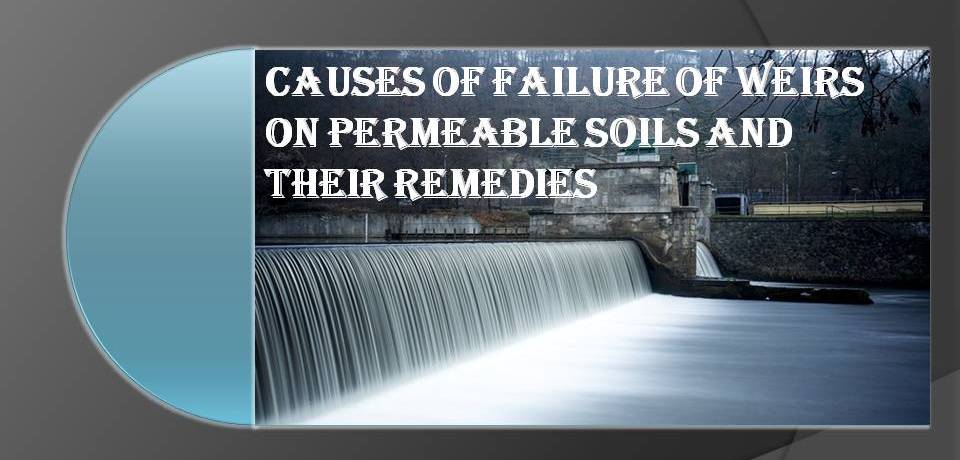
Failure of weirs on permeable foundation
Design of impervious floor
Bligh’s Creep Theory

Khosla’s Theory
 Civilengineering